

You can scrub until your shoulders hate you and still end up with that same smug haze when the sun hits the pane. That’s the tell: persistent streaks usually aren’t about effort. They’re about what’s bonded to the surface (minerals, detergents, airborne grime), or what’s happened to the surface over time (micro-scratches, coating damage, etching).
And yes, sometimes the glass is the problem, not you.
One-line truth: “Clean” glass can still look filthy if residue chemistry is winning.
The streaks are data (annoying data, but still)
If you watch when the streaks appear, you’ll narrow causes fast. And if you’re dealing with persistent issues and need professional help, window cleaning in Hickory, NC can make a big difference.
– Streaks that show up only after drying: classic dissolved solids left behind (hard water) or leftover surfactant (too much cleaner).
– Cloudy edges or “tide lines” near corners: water is pooling, evaporating slowly, and dropping minerals where it sits.
– Milky cast that worsens when you buff: you’re re-smearing a thin film (soap residue, old coating breakdown, or cleaner incompatibility).
– Random dull patches that don’t change no matter what: could be etching or micro-pitting. That’s not dirt, that’s damage.
Look, if the problem moves around when you wipe, it’s residue. If it doesn’t, you might be fighting the glass itself.
Window “science,” but in plain English
Cleaning glass is a three-part event: dissolve, suspend, remove. Miss one part and you’ll chase streaks forever.
Evaporation is the silent saboteur
Hot pane + sun + volatile cleaner = fast evaporation = solids left behind. If you’ve ever cleaned a window that looked perfect… until it dried in two minutes and suddenly wore zebra stripes, you’ve met this problem.
Humidity flips the script. In high humidity, moisture hangs around longer, which sounds helpful, but it also encourages slow drying and uneven runoff, especially around frames.
Your glass may be older than your habits
Aging glass can develop surface changes that grab onto residue more aggressively. It also scatters light differently, so films become more visible even when they’re microscopically thin. Same residue, worse appearance.
Tint and coatings are picky roommates
Tint films and some low-E coatings can react badly to the wrong cleaner. Ammonia is a common offender. It can haze certain films, weaken adhesives, or leave a persistent “smoke” look that feels impossible to buff out. Use products labeled tint-safe and resist the urge to go nuclear with solvents.
Now, this won’t apply to everyone, but if your “glass” is actually a film layer, your cleaner choice matters more than your technique.
Hard water: the streak machine
If you have hard water, you’re not cleaning, you’re doing mineral management.
When tap water dries, it leaves behind dissolved calcium and magnesium. That deposit is why the pane looks dull even after you “cleaned” it. It’s also why you’ll see recurring spots in the same places: drip paths, sprinkler spray zones, bottom edges.
A concrete number helps here: water is generally considered “hard” when it’s above 120 mg/L (ppm) as CaCO₃, and scaling becomes increasingly likely as it rises beyond that range (USGS Water Science School, “Hardness of Water”). That’s the territory where windows start acting cursed.
What works in the field (and what I’ve seen save people hours) is a two-stage approach:
- Wash with a mild detergent solution to loosen oils, traffic film, and grime.
- Rinse with distilled/softened water so you don’t add new minerals while “finishing.”
If you skip the distilled rinse, you can do a flawless job and still lose at the final drying step.
Soap residue and “invisible” film: your cleaner might be the culprit
Here’s the thing: most streaks I diagnose in homes aren’t from dirt. They’re from product overload.
Too much glass cleaner (or dish soap, which people love) leaves surfactants behind. Those surfactants dry unevenly and create that smear that only shows up at an angle. Worse, if you keep re-spraying and buffing, you’re basically laminating the window with a thin detergent layer.
Quick tells:
– The glass feels slightly slick after it “dries.”
– Streaking gets worse the more you polish.
– A plain distilled-water wipe improves it more than another cleaner pass.
If that’s you, reduce product concentration, rinse more, and rotate cloths. A “clean” microfiber that already has detergent residue in it is a streak factory.
Micro-scratches, pollution, and the stuff you can’t out-scrub
Unpopular opinion: aggressive scrubbing is how people permanently ruin their windows.
Micro-scratches don’t always announce themselves until sunlight hits at the right angle, then suddenly your “streaks” are etched lines that never change. Abrasive pads, gritty towels, and even dust dragged across the pane can do it. Add urban grime, oils, tire dust, industrial fallout, and you get a film that bonds like it’s paying rent.
Climate piles on too. Acidic rain events, salt air near coasts, and freeze-thaw cycles around seals can cause surface pitting and edge degradation. You can clean all day and still see dullness because the surface is no longer optically smooth.
If you’re seeing:
– persistent dull patches,
– tiny “freckled” pitting,
– roughness you can feel with a fingernail (gently),
…that’s when I stop recommending DIY chemistry experiments and start recommending assessment. Sometimes restoration polishing is possible; sometimes replacement is the honest answer.
A practical plan that doesn’t rely on magic
Some sections of window care are… weirdly emotional. People take streaks personally. Don’t. Use a process.
Tools (keep it simple)
– 2 microfiber cloths (one for wet work, one for drying)
– A squeegee (optional, but it helps a lot)
– Mild glass cleaner or a few drops of gentle detergent in water
– Distilled water in a spray bottle for final passes
– A small bucket
The method I trust
Dust first. Dry. Always. You don’t want to turn grit into sandpaper.
1) Pre-wipe frames and sills with a barely damp cloth so you don’t drag frame grime onto glass. (Don’t blast cleaner into the seals. It migrates.)
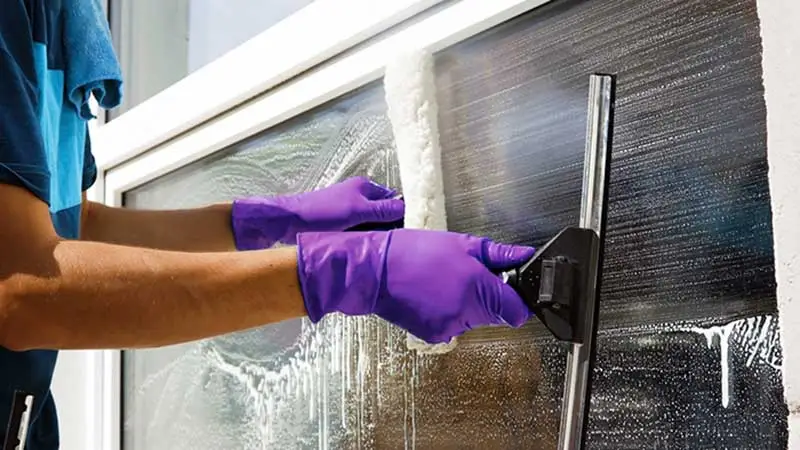
2) Wash the glass with your diluted solution using consistent strokes. Vertical is fine.
3) Remove the solution: squeegee top-to-bottom, or wipe off with your “wet” microfiber and immediately follow with the dry one.
4) Final rinse pass with distilled water. Light mist, then wipe horizontally.
This is where stubborn “mystery streaks” often disappear.
5) Detail the edges with a clean corner of your dry microfiber. Edges are where residue goes to hide.
If streaks remain after the distilled step, that’s a big hint you’re dealing with mineral etching, coating damage, or embedded contamination, not leftover cleaner.
When vinegar helps… and when it’s a bad habit
People love vinegar. Sometimes it earns the hype.
A light vinegar solution can help dissolve mineral deposits. But acids used repeatedly (or used too strong, too often) can contribute to surface changes over time, and they can be risky on certain coatings and nearby materials. If you try it, test a small corner first, keep it brief, and rinse thoroughly.
If the deposit doesn’t budge after a couple controlled attempts, stop escalating. Stronger acids and aggressive pads are where “cleaning” becomes “damage.”
The real win: stop re-depositing the problem
The best window cleaning isn’t about finding the strongest product. It’s about not leaving anything behind, minerals, soap, lint, or grit.
Work in shade when you can. Use less chemical than you think you need. Distilled water is boring, but it’s brutally effective. And if the glass still looks streaky after you’ve removed everything that can be removed, you may be seeing the surface itself telling its story.